


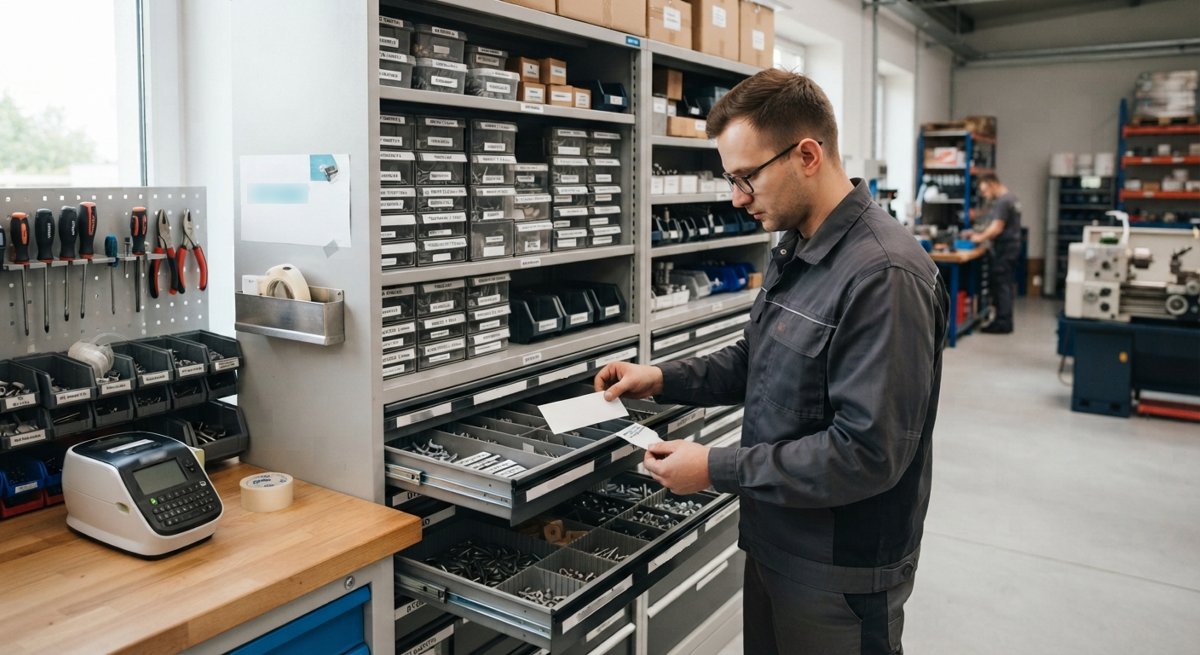
There is something quite characteristic about Finnish workplaces. Whether you are in a workshop, a warehouse, a production facility or even an ordinary office, sooner or later you will come across… a label.
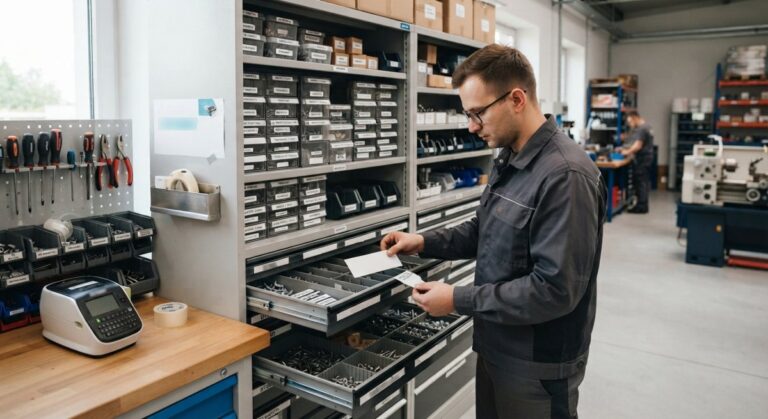
A cabinet? Labelled. A shelf? Labelled. A box? Of course, labelled. Sometimes you might get the impression that in Finland, anything that hasn’t been labelled yet is simply waiting for its turn.
And while this may seem like a small expression of the Finnish love of order, there is actually something much more practical behind it. The idea is to make the workplace predictable, organised and safe.
This is where the 5S method comes in.
Its roots go back to Japan. The method became one of the foundations of just-in-time production, and its development is associated, among others, with the work of Hiroyuki Hirano published in the 1990s. The basic idea, however, is older and forms part of a much broader history of looking for better ways to organise work.
At first, the main goal was efficiency. Less clutter means less wasted time, easier access to tools and smoother work. But it soon became clear that the same approach had another important benefit: a well-organised workplace is simply a safer workplace.
And you don’t really need any complicated theory to understand why.
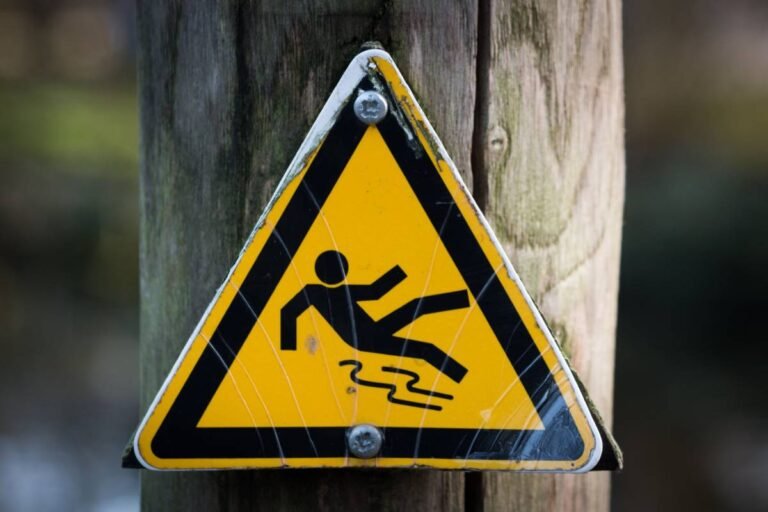
Imagine a workstation where, over the course of several days, you have been putting things aside “just for a moment”. An unnecessary tool is lying on the floor. An empty package is sitting on the table. A cable is running across the walkway. The wrench you will need in five minutes has somehow disappeared.
Nothing serious. Until you trip over it.
The first “S” in 5S is seiri, or sorting. In practice, it means something very simple: get rid of what you don’t need. The fewer unnecessary objects there are around your workstation, the fewer things there are to get in the way, fall over, cause an accident or end up exactly where they shouldn’t.
Then comes seiton — set in order. This is where we decide where the things we actually need should be kept.
And this is where that label comes in.
A Finnish Dymo label printer may not seem like a particularly impressive piece of equipment. It is hardly comparable with a modern production machine or an advanced safety system. Yet it has its role. When every tool has its place, every cabinet is labelled and every necessary item can be found without guessing, work becomes more predictable.
And predictability in the workplace matters.
Especially when something starts to go wrong.
If, during an emergency, you have to spend several minutes wondering where the first-aid equipment, fire extinguisher or appropriate tool is, organisation stops being a matter of aesthetics. Suddenly, all those labels start to look like a pretty practical idea.
The third “S”, seisō, means cleaning. But this isn’t simply about making the workplace look good before the supervisor comes around.
Cleaning can also be an inspection.
When you regularly clean a machine, workstation or tool, you get a chance to notice things that might otherwise go unnoticed. A small leak. A damaged guard. A cracked component. A loose connection.
Dirt can hide a lot of things. A clean and organised workplace makes problems easier to spot.
And this is where 5S starts to become really interesting. Because now it is creating an environment where it is easier to notice when something is wrong.
The fourth “S” is seiketsu. It can be associated with standardisation and maintaining an agreed level of order and hygiene. In other words, it is not enough to clean everything up once.
If everything looks perfect on Monday but nobody remembers where anything belongs by Friday, it is difficult to call that a real system.
You need simple rules that make it possible to maintain the same standard every day. Everyone should know where things belong, what the workstation should look like and what to do when they notice a problem.
And finally, there is shitsuke — discipline.
This is probably the hardest part of the whole system.
It is easy to have a big clean-up. It is much harder to keep things that way for the next six months.
5S only really works when order stops being a one-off project and becomes a daily habit. Regular reviews and audits can help, but the involvement of the whole team is just as important. If only one person is responsible for keeping things in order, the system will eventually start to fall apart.
And this is why many organisations use another version of the method — 6S.
The sixth “S” is Safety.
In this approach, safety is not something that comes at the end, once everything else has been taken care of. It is part of the whole system. Order, organisation, cleanliness and standards are not only intended to make work more efficient, but also to reduce risk.
That means actively reporting hazards, responding to problems and providing regular training for employees.
And perhaps this is the point where 5S stops being a Japanese management method that we read about in a textbook and becomes something much more everyday.
Because, in reality, 5S doesn’t have to look like a complicated system.
Sometimes it looks like a shelf where everything is exactly where it should be.
Sometimes it is a clean floor with no overturned box lying in the way.
Sometimes it is a tool put back where it belongs.
And sometimes it is simply a small label printed on a Dymo.
Is that enough to guarantee safety? Of course not. No workplace organisation method can replace proper equipment, procedures, training or common sense.
But it is worth remembering one simple thing: safety often starts with things that seem completely insignificant.
With where you put your tools.
With whether you notice a leak.
With whether you know where the equipment you need is kept.
With whether the next person working at the same station will know what is what.
Whether you work in the port of Helsinki, a workshop, a warehouse, a production facility or an office in Tampere, the principle remains the same.
Order is not the goal in itself.
The point is to make it easier to work well — and safely.
–
Take 5S further
Want to learn more about how workplace organisation and 5S principles contribute to a safer working environment? We cover these topics as part of our Occupational Safety Training and SFS 6002 Electrical Safety Training courses. Both courses look at workplace safety from a practical perspective and help you recognise hazards, work systematically and make safety a natural part of your everyday work.